
Visiting Family in England – Part 2

The old city gate into Canterbury.
Warning: Part 2 of our vacation saga is a bit long and contains a few side excursions on my part into theatrical review and international commerce.
Day 4: Our first major adventure. We all took the train into Canterbury for shopping and theater. Canterbury is the largest city in this part of Kent, so it’s a major commercial center, but it’s also a very old city with a long and storied history. The ancient and modern exist side by side here. We’ve visited in the past and toured the Cathedral (well worth it!) and other historic sites in the city.
But history was not on the agenda for this visit. The first order of business was looking for school shoes for the children. Unfortunately, we came up pretty much empty-handed in that effort, despite checking a number of different shops. We consoled ourselves with a great lunch at one of the family’s favorite restaurants and then headed onto our main focus of the day, the theater, or theatre as the Brits would spell it. The Marlowe Theatre (https://marlowetheatre.com/) in Canterbury is a wonderful (and very modern) venue that attracts major shows and traveling companies of West End productions.
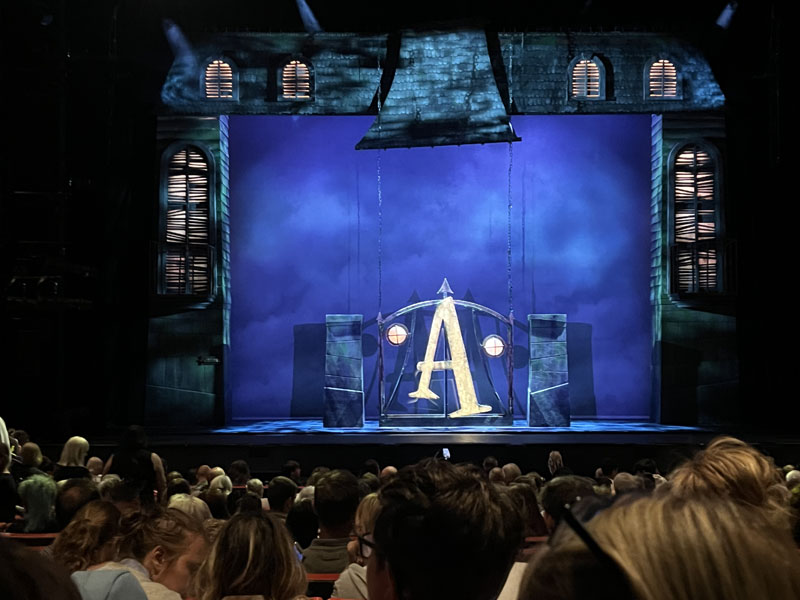 We were there to see The Addams Family Musical, with most of the original West End cast, including a well-known British pop star in the role of Morticia, and live orchestra. We chose it for the potential to be a show adults and children would all enjoy. It proved an excellent choice. We had a great time and were very much engaged with it, though I doubt any of us had the same experience.
I go back a long way with The Addams Family. The original television show was one of my favorites when I was a teenager back in the 1960s. I’ve seen most of the subsequent movies and shows, most recently Wednesday on Netflix. It remains a wonderful concept: a family of bizarre, even monstrous creatures, who nonetheless regard their strange family and living circumstances as completely normal. They’re a strong, loving group, too, who accept each other as they are and support each other unconditionally. The humor generally comes from their often blithely naive interactions with the rest of the world.
The underpinning story of the musical settles into that concept and is saturated with exactly the kind of gently absurd clash of cultures that makes the Addams family so wonderful.
The play also includes excellent acting, wonderful production numbers, some unthreateningly spooky action, and great humor. The children enjoyed all of it, including the ice cream at intermission! The adults did, too. From the first moments of the overture, which included echoes of that uber-catchy original television show theme, to the very end, we were entertained and diverted. We all voted it a huge success.
Perhaps my favorite aspect of it was their treatment of Gomez. Too often, the casting of Gomez seems like an afterthought, not surprisingly since the character is also generally underwritten, if not outright ignored. I loved John Astin in the role, but the less said of the many that followed, the better. (I might give Raul Julia a pass. He tried, though the writers gave him little to work with.) But this play gives Gomez center stage with the moral dilemma that drives half the plot. He’s suave and compelling, but he’s also the strong, beating heart of the family, a worthy partner for the deliciously sexy, slinky Morticia. The pop star playing Morticia was a decent actress with stunning vocal chops, and Uncle Fester chewed the scenery in a role designed to do just that. But Gomez was at the center of the action and he carried it well.
Despite the failure to find shoes, we all voted the day a triumph due to the play.

James with Cricket bat, guarding the wicket.
Day 5: We’re off on another adventure, though lower key and completely different from the trip to Canterbury. James, 9, is the family athlete. If there’s a sport going on anywhere in the vicinity, he’s likely to be involved. And he’s also likely to be good at it. That Friday his local Hythe youth Cricket team played in a regional tournament. We didn’t get there until late morning, but still in time to catch the end of one game and see the entirety of his last match of the day.
I even acquired some hazy notion of the rules of Cricket, which bears a slight resemblance to American baseball. They were playing a modified version of the game, adjusted for younger players. James was again clearly better at it than most of the others on the team. He was the only pitcher (excuse me, bowler) on either team we saw actually hit the wicket with a ball (one of the objects of the game). On
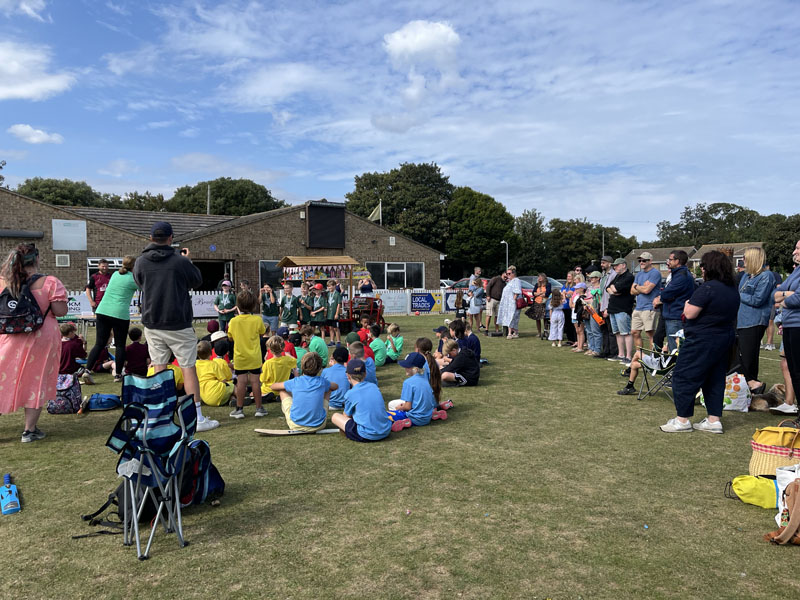
Awards Ceremony
the defensive side, when he was fielding, he was also the only player watching the batter and positioning himself based on which way the batter was turned, to be ready to stop a ball coming his way. His team took third place out of eight, a pretty good result!
James’ sister Freya introduced me to the “Sweets cart,” which was selling mix and match candy from a plethora of jars. We made a selection of various sorts. I ate a couple and found them okay if mostly not to my taste, but than other chocolate and mints, I haven’t eaten much candy in a very long time. Freya handled the sweets I couldn’t finish.
We went back to their house and celebrated with pizza.
 One of the more interesting features of the day was that we had to drive through Dover on the way to and from Deal, the town hosting the tournament. Dover is famous for its white cliffs and the fact that it has long served as the main ferry route from Brittain to the continent. It still does, but these days that service involves more commercial traffic than human. A lot more. On a Friday morning, trucks lined the left lane of the four-lane highway into Dover, backed up for at least ten miles from the port.
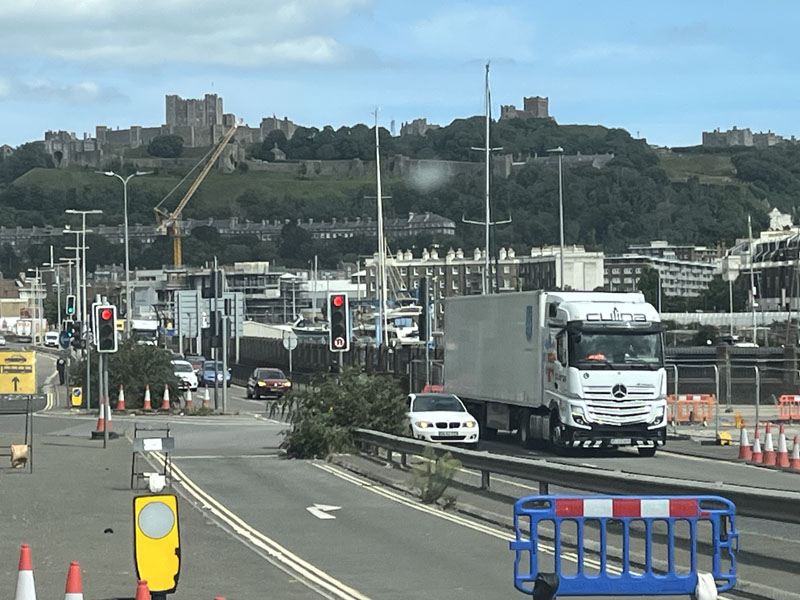
Dover Castle on the hill in the background.
Every day, huge ferries loaded with trucks (lorries in the local terminology) cross the English Channel, transporting goods to and from the continent. The trucks line up along the highway waiting their turn to make the crossing. Steph told us the government was working on building a holding area, but meanwhile, there’s no place else for the trucks to wait They queue up in the left lane, allowing traffic to pass on their right. (Keep in mind the English drive on the left side of the road, so the trucks are in the equivalent of the right lane in America. Also the British are good at queueing up. It’s well organized, with trucks pulling into the back of the line as they arrive. No jockeying for position or attempts to cut in ahead. At least none that we saw.)
And presiding over all the traffic, on top of one of those famous white cliffs are the stately remains of Dover castle.